Wednesday, July 9, 2014

Consistency

I am a landlord. This is not to suggest that I am some kind of a wealthy landowner with cash coming out of my pockets.. Last year, my wife and I purchased a duplex home, with the intent of renting out the upstairs apartment to reduce our costs.

It has been no picnic. Our first tenants, Avril Leslie (AKA "April Leslie," as if we don't know what Avril means in French) and Eric Ford (also known as Erie Ford) were our first tenants. Turns out they are professional scam artists, living off of one landlord after another by suing them for stuff that was not wrong with the apartment. They sued us for mold that was non-existent. The scam was to initiate a lawsuit and then they would not need to pay the landlord any rent. They did have to pay the Court, though and they were very careful to do that.

Then they get crazier and crazier, making the landlord worry about what must have happened to the apartment with them inside of it. But they didn't reckon with us. We informed them that they were in violation of the rules of the lease. We did everything very legally. They had signed a lease permitting one car in our driveway. We towed one. We noted that Avril has specifically applied for the apartment with the intention of moving her daughter in. Then she proceeded to take her daughter to school every day at a nearby town, which is theft of town services. We went over to that town's town hall and produced evidence they needed to expel her daughter. While I do not think they did that, life became a real struggle for Avril. We do not recommend to any landlord that he or she ever rent so much as a lean-to shed to them.

They moved out. But during this process, we were in court a lot and we watched the judge.

The judge tended to favor tenants and nail landlords. Landlords sell time. And the one thing one cannot get back is time. Once it passes, that's it. So rulings against landlords were particularly galling to us. But some won when a ruling had all ready been made by that self-same judge. You see, he was consistent.

Above every judge, there is an appeals court. Judges need to be consistent so that, if any case of theirs is appealed, they can justify their rulings as in keeping with a general thrust of judgements. These judgements, over time, wind up being how law is interpreted, especially in the appellate courts in a system called "English Common Law," or law by precedent.  This is distinguished from statutory law, which is generated as a bill by a legislature and signed by a chief executive and is complementary to it. This is to say that the two work together to create a structural framework for a country that fits the needs of the country as developed over time.

Here, we see our Supreme Court as in direct violation of the premise that common law needs to be complementary to statutory law. This is staggering. Every single Republican nominee to this court swore before the Senate of the United States in their hearings that they were not "activist judges," that they would interpret the laws and the Constitution and not make law from the bench.

Here, we see five Justices more than willing to write legislation in their decisions. The first one is, of course, the decision in Citizens United. According to Politifact, they did not "overturn 100 years of lawmaking to limit political contributions." I disagree. In his 1905 address to Congress, Theodore Roosevelt recommended that Congress act to restrain corporate contributions, The resultant Tillman Act was signed into law by Roosevelt on January 26, 1907. Congress has been trying to control corporate funding of elections since then.

Now, What is going on here is this reinterpretation of the 14th Amendment to the Constitution, which, in Section I states:
All persons born or naturalized in the United States, and subject to the jurisdiction thereof, are citizens of the United States and of the State wherein they reside. No State shall make or enforce any law which shall abridge the privileges or immunities of citizens of the United States; nor shall any State deprive any person of life, liberty, or property, without due process of law; nor deny to any person within its jurisdiction the equal protection of the laws.
Now, at issue here is the word "persons." As a matter of interpretation of the word "person" in the Fourteenth Amendment, U.S. courts have extended certain constitutional protections to corporations. This allows them to get into contracts, to sue and be sued and to do all manner of things that real humans can do, once they are 21 or older.

And this particular Supreme court seems to think that, since they cannot vote, corporations ought to be able to spend way more money influencing politicians and our political process possibly can because they cannot.

I would like to think that one thing that government ought to do is to level the playing field between the super-rich and the poor, the corporations and the individual. Of course the right calls that "class warfare." I have read about "class warfare." It did happen, you know. In the French Revolution. Wealthy persons were dragged out of their homes and killed on the spot. Now that is class warfare. What the right is complaining about is how their special rights are being threatened just a little.

So let us get into this issue of special rights. In this last session, the Supreme Court has decided that "Closely-held Corporations," a term that the majority refused to define, have special rights to completely ignore US law. The only law they suggested that these corporations need to follow is tax law. They can discriminate against women and have all ready begun discriminating against persons whose gender preference offends the "closely held" owners. What's next? reversal of all civil rights for "closely-held corporations?"

So, now the Supreme Court has established a principle that corporations can exercise and promote religion. And they can do so without any respect to the rights of the persons who happen to have flesh and blood, skin and brains. You know, the ones that Thomas Paine was writing about in 1791. If I ever again hear anything that the right and the five activist right-wing Justices say about "the founders" again, my "BS" meter will be pegged. I let the reader discern what kind of barnyard smell the "BS" meter is designed to detect.

Three of the flesh and blood "persons" on the United States Supreme Court happen to be women. And I have to say that when Bush replaced the first female Justice, Sandra Day O'Connor with John G. Roberts, an opportunity to have four women on the Supreme Court was lost. O'Connor eventually allowed her feelings to be known about Bush's decision to keep the same number of women on the court. She thought Bush's choice to be disappointing. One can only imagine what might have happened with the Hobby Lobby decision had there been four women on the Supreme Court.

Alito agreed with the Majority opinion, but it is interesting to see his dissent in another case. in the 2011 decision Snyder v Phelps, to give Fred “God Hates Fags” Phelps the First Amendment right to picket funerals of dead marines, the court ruled 8-1 in Phelps’ favor. Scalia dissented, saying "Our profound national commitment to free and open debate is not a license for the vicious verbal assault that occurred in this case." He referred to Snyder as having been "brutalized" by Phelps. Then, right away, he ignored this decision in agreeing with a 5-4 majority decision to erase "buffer zones" around parental planning clinics which provide abortion services in McCullen v Coakley. I guess he thinks bombings, shootings of physicians and screaming at women entering these clinics is not brutalization.

Despite the presence of three women on this court, you should be afraid in the United States if you are a woman. Corporations have more rights than you. There is no consistency in law that protects women.


Thursday, July 3, 2014

The most Liberal Revolution

JFK in 1946
John F. Kennedy in 1946
Today, I read Ira Stoll's opinion piece in Time Magazine, suggesting that the Patron Saint of the Democrats, John F. Kennedy had made July 4th into a religious holiday. He then proceeded to twist Kennedy's words, uttered in 1946 when he was not running for President; when he was running for a Massachusetts Congressional seat and proceeded to conflate a speech given in front of a few hundred in front of Faneuil Hall with a philosophy for the entire Democratic Party as well as the Kennedy Presidency.

I would remind Mr. Stoll that the Patron Saint of the Republicans, Ronald Reagan was a Democrat at the time Kennedy made that speech. He switched his affiliation in 1962.

Kennedy was speaking to a largely Irish Catholic crowd who he knew would vote for him. But Stoll seems to think that this makes the American Revolution into a Religious revolution and proceeds to try to redefine our Liberal Revolution as some kind of a religion-inspired Christian-based movement. Nothing could be further from the truth. Conservatives continue to call our Revolution a "Christian Revolution" and a "Conservative anti-tax Revolution." This is absolutely false.

Kennedy and the rest of Congress did want to make a stand against "Godless Communism," as they saw it as a threat to the United States. The desire to oppose the Soviets came about because of the increasingly hostile stance between the Soviets and the western world. We do this today, opposing Sharia Law (without understanding anything about it) and by "trying to foster Democracy" (when the United States is a Republic with representatives, not a Democracy) in countries that are mostly Muslim-dominated these days.

Mr. Stoll loves to "cherry-pick" history and take things out of context to fit into his scheme to take back our Liberal Revolution so that it supports his Conservative aims. Were he a staunch Conservative then, he would have been called a "Loyalist," and certainly would have lost all property he owned in the United States in his move to Canada or, perhaps, England. Please see my earlier article dealing with that.

King George III painted by Zoffany around 1770
King George III around 1770
Mr. Stoll completely forgets who, exactly, the Continentals were revolting against. King George III, By the Grace of God, King of Great Britain, France and Ireland, Defender of the Faith, Archtreasurer and Prince-Elector of the Holy Roman Empire, Duke of Brunswick-Luneburg.

Since Mr. Stoll doesn't seem to know what all that means, allow me to translate. George III was King "By the Grace of God." This is a reference to the Divine Right to Rule: A political and religious doctrine of royal and political legitimacy. It asserts that a monarch is subject to no earthly authority, deriving his right to rule directly from the will of God. Not only did George III claim that he had this divine right, but he was also arbiter of all things divine here on earth, as he retained the style given to Henry VIII, "Defender of the Faith." In other words, George III proposed that he was subject to no earthly authority and that he, alone, would determine and defend the will of God.

The Declaration of Independence was primarily addressed to King George III and his Parliament but was also meant to be read by other countries. It was a diplomatic document designed to allow for the recognition of the United States by foreign powers, which would enable us to ask for loans from the French King, Spain, Holland and other governments. The Sultan of Morocco mentioned American ships in a consular document as early as 1777 and this must really have bothered England, as they commissioned propagandists to point out the declaration’s flaws and rebut the colonists’ complaints.

As such, one needed to write a document that would be read widely and understood by all governments, no matter what their societal and religious views.

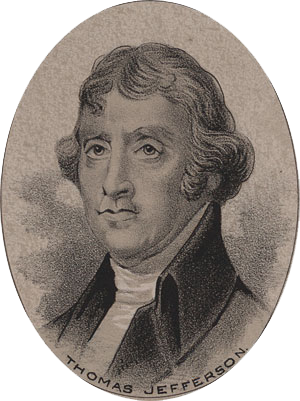
Thomas Jefferson, around 1776
Thomas Jefferson, John Adams and Benjamin Franklin were commissioned by the Continental Congress to write the Declaration. And this document was researched, unlike Mr. Stoll's opinion article in Time. The idea that any part of a kingdom could claim legitimacy for breaking away from another part of a kingdom, let alone its ruler (divinely-ordained, by the way) was pretty earthshaking. So Jefferson drew from several sources that he referred to as giving us the right to do this.

The first source was an act of Parliament in February 1776, called the Prohibitory Act. This, essentially, called for a blockade of all Colonial ports and declared all ships from these shores to be enemy vessels. I am certain that Mr. Stoll would agree with me that a port blockade is an act of war and that allowing any and all of your ships to declare ships from a certain region as enemies, when all they are doing is carrying goods for sale and picking up more goods to bring here a bit rash. But maybe there is religion involved. Maybe God wanted all of our shipping sunk. In the declaration:
He [George III] has given his assent to… legislation… cutting off our trade with all parts of the world. He has plundered our seas, ravaged our coasts, burned our towns, and destroyed the lives of our people. He has constrained our fellow citizens taken captive on the high seas to bear arms against their country, to become the executioners of their friends and brethren, or to fall themselves by their hands.
Remember, the Conservatives here are thinking the King is justified. After all, God made him King and absolute arbiter of divine will.

The most telling example of Jefferson's patient research is this:
He has abdicated government here, by declaring us out of his protection and waging war against us.
King James II of England, who fled and was declared by Parliament as having abdicated the government
James II of England Abdicated by Fleeing
This is a direct reference to the Revolution of 1688, also known as the Glorious Revolution in which King James II of England was overthrown by a union of English Parliamentarians with the Dutch stadtholder William III of Orange-Nassau. James II fled to France on December 23rd of 1688. On January 28th, 1689, a committee of the whole House of Commons decided by acclamation that James had broken "the original contract"; had "abdicated the government"; and had left the throne "vacant." What Jefferson is doing in the line above is offering a similar declaration that the "throne was vacant" here in the Colonies because the King had abdicated by these acts of war. We were, thus, allowed to create any form of government we so chose.

This was a very careful argument and quite devastating to the King of England.

Our religions, as practiced here in the Colonies had nothing to do with this. The mention of "the laws of nature and of nature's God," "their Creator,"the "Supreme Judge of the world" and "reliance on the protection of Divine Providence" do not make the Declaration into a religious treatise but, rather, offer enhanced legitimacy to the opposition of the King's "divine right" to rule here.

Wednesday, July 2, 2014

Breathtaking

Worst President Ever
Do you remember the Bush Administration? I sure do. It seemed, every week brought with it another breathtaking development in neo-conservitive overreach, from GW Bush's signing statements, refusing to execute laws passed by Congress to the disastrous war in Iraq that, today, has a country we don't like ascendant in that region (Iran) and a country he said would be a "cradle of Democracy in the region" involved in a civil war.

And the explanations given for overreach were breathtaking, too. Iraq had Weapons of Mass-Destruction; they had purchased yellowcake uranium for enrichment, they were making an atomic bomb (no, that was Iran, who Bush put in the catbird seat in the region). They were funding terrorism (again, Iran). They were a safe-haven for terrorists (not until after we invaded and then didn't govern them—and that was Afghanistan, where Bush let the terrorists get away in the mountains of Tora Bora along the border with Afghanistan and the ungoverned region in Pakistan).

Worst. President. Ever.

But now, we have the same thing happening. Not in the Executive, but in the Judiciary in the Supreme Court. It used to be that only one Justice on the Supreme Court was violating the rulings that he, himself had previously made. That was Clarence "The Clown" Thomas, whose rulings vie with each other as the most contradictory and the most politically-motivated. I brace myself as we approach July now as we begin to hear the rulings of the Roberts Court with their five-to-four rulings that, once again, take my breath away as uniquely bad. Three women sit on this Court and each of these three women were opposed by almost every Republican in the US Senate for confirmation.
The US Supreme Court since 2010, known as the Roberts Court
The US Supreme Court with all smiling, save Clarence, the Sad Clown.
This latest decision in the Hobby Lobby case is breathtaking because the majority (a bare five) decided to take an obscure law, the Religious Freedom Restoration Act of 1993, and twist it, applying it as a specific test that allows corporations to discriminate against women in the workplace. Oh, they state that only "closely-held corporations" may apply their religious objections and discriminate against a class of US Citizen, but they utterly fail to define what a "closely-held corporation" is and leave it to lower courts to hash it out.

I read through their tortured logic and it is very clear to me that they believe Corporations are people. This is a belief that completely defies logic. As Ruth Bader Ginsburg in her marvelous dissent stated:
"In a sole proprietorship, the business and its owner are one and the same. By incorporating a business, however, an individual separates herself from the entity and escapes personal responsibility for the entity’s obligations. One might ask why the separation should hold only when it serves the interest of those who control the corporation."
Let me explain this a little better: You own a company. When you own a company, you assume risk. The work that you do may generate lawsuits if it is shoddy. Someone trips on your office step and you may be sued for negligence (you did not clear the snow, your step is loose, etc.). All of these can be offloaded to "not-you" if you incorporate. Now, in many ways, a corporation can wind up with a lot more risk than an individual. And, with respect to lawsuits, corporations sometimes face awards in the millions that an individual might never have to pay. But your personal bank account and your personal accountability are completely separate from those of the corporation.

But we're talking rights here. And I have to ask, why is it that these five Justices think that a corporation gets "special rights?" I seem to recall that every time "The Gay" came up in terms of rights, Republicans would term any laws that afforded "The Gay" equal rights to heterosexual citizens, they were "special rights." While everyone with any sense understands that equal rights are not special rights, these five justices have just created a special rights case for something that they call "A closely-held corporation." I'll bet "closely-held corporations" will want to discriminate against "The Gay" next, because it is against their religion to tolerate "The Gay."

Hobby Loby Discriminates Against Women
Here's the deal: They can now pay less for employer-provided benefits so that they can discriminate—based on some religious beliefs that they decide is pertinent. This means, they have an advantage over non-closely-held corporations, like GE. If I was Pfizer, I would be going crazy at this ruling. Conestoga and Hobby Lobby now can get lower-cost health insurance coverage because of the board of Directors' religion and I cannot.

Now I am omitting, here, the whole "special rights" they get that regular citizens can't get. Regular citizens cannot go out and buy a health insurance plan through the Affordable Care Act's website without needing to pay for all manner of contraceptives. This means that a minister who believes that there should be no contraception cannot sign up for health insurance on the healthcare.gov website and avoid paying for women getting contraceptives, but "closely-held corporations" can create a special instance where they can negotiate lower rates, based on some made-up religious intolerance to women.

Now of course the headlines on Facebook are funny today:

Supreme Court Rules JCPenney Allowed to Sacrifice Employees to Appease Cthulhu
SUPREME COURT UPHOLDS LITTLE CAESAR’S RIGHT TO FEED CHRISTIAN EMPLOYEES TO LIONS
Hobby Lobby Stones Gay Employee to Death
Closely-Held Corporation Imposes Sharia Law
Welcome to the USA Where Corporations are People but Women Aren't

What is not funny is how a special class of corporation has just been created that can, essentially, get around all US law on the basis of religious objection. All so that the five men on the Roberts Court who agreed with this tortured decision can single women out for special discrimination.

I note that Hobby Lobby's retirement plan held more than $73 million in mutual funds with investments in companies that produce emergency contraceptive pills, intrauterine devices, and drugs commonly used in abortions when they filed their suit to discriminate against female employees.

I guess, where money is to be made, nothing violates one's religious principles, but where money is to be spent, those principles are paramount.

Monday, October 7, 2013

Treason

Treason is defined as "Violation of allegiance toward one's country…especially the betrayal of one's country by waging war against it or purposely acting to aid its enemies." It is also defined as "A betrayal of trust or confidence."

Speaker John Boehner has committed treason
John Boehner should be charged with Treason. And every member of the House of Representatives who have decided that, in order to repeal a law they don't like, they will prevent the government of the United States from fulfilling its obligations—which they voted to create. Boehner and the Republicans have violated their allegiance to the United States. Our government is in a partial shutdown. Frankly, I'm unhappy with that. The shutdown should be total. Troops ought not to be paid. No processing should happen. All actions of the American government should be suspended, including check processing for members of Congress and the President.

Here are the Republican arguments: Firstly, they want to call the Affordable Care Act a Bill. It is not. It is a law. It was passed by a majority of Congress and signed by the President. Done. Second, Republicans say that the Affordable Care Act was never debated or there was, somehow, insufficient debate. There was lots of debate. I attended one public meeting that was hosted by the US Chamber of Commerce. And they had a guy in the front of the room who sold everyone a huge pack of lies that I haven't trusted any statement from the US Chamber since then.
The United States Supreme Court affirmed the Constitutional
status of the Affordable Care Act, or Obamacare.
Republicans are now saying that the United States Supreme Court rewrote the law. The US Supreme Court interpreted the law (that is what they do, you know) and they interpreted the fine in the "required to carry insurance" part of the law as a tax, since it is collected by the US taxing authority, the IRS.

In face, pretty much everything Republicans and their masters have said about the Affordable Care Act is false. It has created jobs. It has improved health care for Americans. And it's just about to make health insurance more affordable for everyone.

Now, these folks who have decided to hold government operations and government payment of debts hostage to a bill that is passed, signed and is law that is in effect right now.  They didn't like it when it was passed, but it was passed by the majority party in Congress. And, the way laws work, you have to get a repeal all the way through Congress and have a President sign the repeal. That is the way it works.

But, for these Republicans, that's not good enough. They believe that one house in our bicameral legislature ought to be able to repeal a law if they just pass the repeal enough times. So far, it's been 40.


This treason being done by the Republican Party is aiding our enemies. One enemy that is being helped out here is the international terrorists. We have put all investigations of their activities on hold. Additionally, since the necessary staff must accompany the President to the APEC summit and the government is shut down, China (which isn't exactly an enemy) will get the head of the table. Our views won't be considered.

Now, what if the shoe were on the other foot? What if Democrats repeatedly passed the repeal of a Republican-supported law in just one house of Congress. Let's say, 40 times. What if Democrats halted all functions of government and halted payment of our debts because they didn't like that Republican law. What if that Republican law were upheld by the Supreme Court?

There would be a bloodbath. Republicans would be screaming bloody murder, encouraging their base to take up arms against any Democrat they could find. And when Republicans demonized Democrats under 6 years of Bush II, they did that unchecked. And Democrats, then in the minority, didn't resort to Treason. Why? Because Democrats understand that majorities aren't permanent. If you change the rules such that a minority is not able to do something in Congress, the other party will do the same to you when you are in the minority.

Senator Lindsay Graham knows the
Republicans may be a permanent minority party
if they run out of "Angry White Men."
So what's going on now? I think there are two things happening. One is that Republicans know they will be called out as liars for how they have demonized the Affordable Care Act. And the other is that Republicans know that 1.5 Million more people in the United States voted for Democrats than Republicans in the House of Representatives and that, despite the fact that Republicans completely gerrymandered districts to create ultra-safe districts for themselves, they are, in the words of Senator Lindsay Graham, running out of angry, white men. Senator Graham was urging Republicans to widen their tent, but the effect the TEA Party is having on the party is that their tent is actually getting more narrow.

Republicans stand to be a permanent minority party once again. So they feel like they don't have to pay any attention to the law of impermanent majority and they can just play dirty from here on out.

Last time we did that, we had a Civil War. And the people that won that had demographics on their side.They were also the states that paid the most into the Federal Treasury.

Saturday, August 10, 2013

America

The McLean House - the site of Lee's surrender
to General Grant, which ended the Civil War
I have been bothered recently by this whole idea of secessionists and secessionism. First of all, the issue was settled back in the Civil War. States may not leave the United States. Counties may not leave states. Cities and towns cannot create their own state or country. That's out. The issue was settled in 1865 with Lee's surrender at Appomattox.

So, what's this stuff about secessionism?

In America, we have our differences but we have always pulled together as a country. Until recently. And the only difference is all about scoring political points—but in reality, it is causing a very real danger to the country.

Here's a recent discussion I had concerning Detroit's bankruptcy that I had on Bloomberg's website:
Detroit skyline
Detroit is one of the signature cities in the United States. As Americans, we all hold the responsibility for this failure. We are also able to assist in the regeneration of Detroit. And we should. Just as all Americans pitched in to buy War Bonds, we should all consider how we can each contribute to a new, modern, efficient and well-run Detroit.

Where are the Motown artists? I would love to attend a concert to raise money. Where are the people who will stand up for Detroit? We're great at describing this failure in detail. How about we put our heads together and create success?
I was stunned by the following reply:
You've got to be kidding. Do you really think someone in Hicksville, NC or Podunk, Wyoming cares or even should care about Detroit? Should anyone, even Detroit residents, contribute further to the corruption and graft that has bankrupt that city?

I do like your reference to war bonds. Detroit is, after all, a war zone.
Snide comment about Detroit being a war zone aside, the poster obviously didn't understand why anyone in Hicksville, North Carolina or some town in Wyoming ought to care. People in all 50 states should care and need to care. Because they're Americans.

I replied:
Searching for survivors in New Orleans after Katrina
Detroit's issues are a disaster that is man-made. And so was the damage wrought by Hurricane Katrina to New Orleans. There were warnings in the case of New Orleans and there were warnings in the case of Detroit.

I recall that Republicans didn't want to rebuild New Orleans. "We can't afford it," was their reasoning. Nothing could be further from the truth. New Orleans largely rebuilt itself, with a little help from the state and very little from Washington. As a result, New Orleans population is approximately 56% of the pre-Katrina population. That means less revenue to the state, less revenue to the city and less revenue to the federal government, as displaced people don't make what they made before. The case for rebuilding New Orleans was made and then ignored. And that was, perhaps, the most un-American thing anyone could have done. Rebuild after Katrina and you get 100% of your tax base back. Don't rebuild and you wind up with a deficit.

This is the same with Detroit. Detroit's population in 1950 was 1,849,568. In 1980, there were 1.2 million people. Today, the population of Detroit is 701,475. That's just a little over half the 1980 figure and one third of the city at it's height. Cities are geared to expand, not contract.

Gutted Apartment Buildings, NYC
I lived in New York in the 1980s and watched as Reganomics destroyed whole sections of the city, many of which looked like the result of the bombings in Germany during WW II. New York grew because its principal source of income, Wall Street, didn't move away to another country, like Detroit's. But NYC also received a great deal of rebuilding money from Washington and Albany. And New York diversified into high-tech, media and other areas besides Wall Street.

In Detroit's case, there has never been the kinds of sums to help rebuild the city and make it prosper or diversify its tax base. If you, personally, were hit by a similar disaster, man-made or otherwise, I'd instruct my Representative and my Senators to make you whole because we are both Americans. Because Americans stand with Americans and don't let one another sink. Because, if we don't, our children will be learning Mandarin in order to get a job in any kind of business. Now, I have nothing against China or the Chinese and I was very proud that we sent rescue workers to that country to help in the wake of their natural disasters (namely earthquakes), because that's what we do here in America. That's what makes us unique in the world.

I would prefer to see our country strong. And our strength comes from Americans helping Americans. If you look at the states in the center of this country, you'll see states that, per capita, send less money into our federal treasury than they get back. These are the truly red states. I grew up in one of them, Kansas. And we prospered because our system was one for all Americans, not just those living in the states that pay the most to the federal coffers. If that were the case, we'd be three or four very different countries—one or two of which would not be in the G-20 (the 20 nations with the largest economies). But that's not the case, because we're all Americans, in it together, pulling for each other.You can go into all the wrongs that Detroit's government has done and sit there on the sidelines and snipe at them. That will get you nothing and Detroit nothing. Me, I like America. I want to see the entire nation succeed and don't want to sacrifice one square inch of our soil.
Senators Coburn and Inhofe, who say
American ought not be for Americans and
Americans ought not support one another in crisis.
Of course, there is this real tide from the right talking about how "we can't afford disaster relief." Two senators, James Inhofe and Tom Coburn held up needed aid to three eastern states after a hurricane hit them. Inhofe and Coburn are both from Oklahoma, a state with very few—if any—hurricanes to its credit.

But then there was this tornado. And then another. And the first one really did a lot of damage in Moore, OK, which is a suburb of Oklahoma City. I was raised in Kansas and, for the most part, a tornado is all about a warning. When they do touch down, they're liable to knock down a barbed wire fence or two, kill cattle, take down a barn.

But we've been spreading out, recently, as a species and what used to be farmland is now suburb. And those areas may get hit by tornadoes.

I live in Connecticut, a state that rarely sees tornadoes and never sees the kind of F4 and F5 types that hit near Oklahoma City. I suppose I could have urged my senators to give tit for tat.

But that's not American.

There’s a quote attributed to Benjamin Franklin that is probably rightly attributed to  Richard Penn in “Memoirs of a Life, Chiefly Passed in Pennsylvania, Within the Last Sixty Years” (published in 1811) that applies here:
“We must, indeed, all hang together, or assuredly we shall all hang separately.”
Of course this was written around the time of the Revolutionary War and "hanging separately" was something the British wanted to do to many of those who signed the Declaration of Independence, served in the Continental Army and the states militias then and served as delegates to the Continental Congress. The last phrase in the Declaration of Independence is as follows:
…we mutually pledge to each other our Lives, our Fortunes and our sacred Honor.
Where is the mutuality in Coburn and Inhofe's rhetoric where they say "we need to offset any disaster aid in savings in the budget?" Where is the pledge to each other in saying "we cannot afford to rebuild New Orleans?" There is nothing mutual and there is no "sacred Honor" in letting Detroit rot.

We are not fifty states. We are America. And I say it's time to start acting like it.

Tuesday, June 18, 2013

Taking back the Revolution

I see a lot of TEA Partiers and conservatives claiming that our 1776 revolution was an anti-tax revolution, was a conservative revolution and that this is echoed today in current events.

Common Sense, pamphlet written by Thomas Paine
Nothing could be further from the truth. Look, it's really easy and popular to oppose taxes because nobody likes paying them. But if we don't, we have to give up roads, bridges, the Internet, trash hauling, police, the military a navy, public storm shelters, interconnected trains that bring us goods, airports, air traffic control, harbors, international relations with trade partners, Indian casinos instead of Indian wars, schools, universities, a banking system, fair trade, and so on. Stuff we all take for granted.

There were conservatives active in our Revolution. They were called "Loyalists." They were relocated to Canada or left to England after the signing of the Treaty of Paris, signed on September 3, 1783 which ended hostilities. In fact, England ended hostilities because the liberals (known as Whigs) took over Parliament and decided peace was more important than trying to beat the American Colonists into submission in a war that had become very unpopular in England.

But that was England. The issue in America was not taxation, in and of itself. It was lack of any representative in Parliament that could argue the Colonists' side or represent the interests of colonial people. In fact, the Continental Congress asked Benjamin Franklin to travel to England to represent our interests to Members of Parliament (since we had no direct representation).

The whole idea of a Parliament is a liberal ideal. The conservatives believed in the Divine Right of Kings—if you were born a prince, you had a right to rule. Here in the American colonies we had, of necessity, been self-governing since being dropped off here in the colonial establishments. Communication with England could entail a three-month trip. The idea of a "right to rule" kind of got fuzzy here, as we didn't have any established monarch on these shores, and many of the wealthy landowners who had been given grants here by the King were absentee—they lived in England.

Congress Voting Independence, a depiction of the Second Continental Congress voting on the United States Declaration of Independence. Oil on canvas.
The Continental Congress Voting Independence
We chose to form a Confederation under Articles that were our "first Constitution." When that very liberal document that gave states rights over that of any central government and that turned out to make self-governance impossible, we chose to re-form our government. The 1787 Constitutional Convention was our SECOND attempt at trying to self-govern. (King George III was absolutely certain that this "generalissimo" George Washington character would be a dictator within a very few years, echoing Oliver Cromwell).

Much of our Constitution (and, if you consider the Articles of Confederation a constitution, this was our second) was a reaction to England. We didn't like how Parliament governed. We didn't like how non-representative it was, with some constituencies very small, others very large, some constituencies populous, others not. So we decided that representation would be apportioned in accordance with population, counted in a census every 10 years. That was very liberal, and it was almost unheard of. It flew in the face of the governance of the Princes of Europe, who set boundaries based on what the nobility had done for them and this patronage system was their system of representation. If you were "in favor," you were better represented. "Out-of favor" meant scant little.

And the forming of a Republic was considered impossible. This was a way radical liberal ideal to form a republic, where the masses would all have a say in governance. So some conservatives (who were very liberal as compared to Europe) thought that it would be better to have representation of the States interests. So the bicameral legislative bodies were set up, with the States choosing their Senators and the masses choosing their Representatives.

Abraham Lincoln from a daguerreotype taken November, 1863
Lincoln knew that the princes of Europe
wished to destroy our Republic
All in all, for its time, our Constitution is a very, very liberal document.

You get confirmation of that with Lincoln, the first Republican President. He affirmed that there could be no breakup of the United States, as he knew that the princes of Europe would just as soon carve up this country and all of its resources in order to create their own little (actually big) fiefdoms here. At the time of Lincoln, "four score and seven years ago," the idea of a representative Republic was a totally liberal idea. The Conservatives went with princes, kings, kingdoms, empires and colonial systems.

The neo-conservatives of today have no claim on the American Revolution or on our Constitution—both extremely liberal, progressive ideals.

Now, I have been told that I'm trying to assign the tenets of today's Liberal and Conservative movements to those of the 1700s. This is not true, either. This is not apples and oranges.

The neo-conservative movement is all about "lowering the burdens of full participation in society for the 'job creators'" which are defined as the wealthy. By lowering the burdens, they mean reducing taxes, omitting regulation so that they may conduct business unhampered by any governmental paperwork, restriction or interference and by allowing businessmen to call the shots.

Sounds great. After all, we would never have had any revolution had it not been for the big corporations encouraging us to… Wait!

British Colonies in America after the French and Indian War
After the Seven-Years War, King George III ceded all land
west of the Eastern Mountains to the Indians
Back in 1776, the cry was "Taxation without Representation is tyranny!" But the Crown was taxing us to help pay for the Seven Years' War which we, in America, call the French and Indian War. We were direct beneficiaries of that war, in that it expanded our land and reduced attacks by the indigenous nations on our settlements. Of course we didn't like the restrictions put on us that the King signed in the treaties with the Indian Nations that kept us hemmed in by the Appalachian and Allegheny Mountains.

The Colonials read the treaty and decided they didn't like it. And I think the treaty made across the Atlantic by people who didn't live here was an additional concern with respect to the lack of representation in Parliament for the Colonials. Certainly young George Washington had familiarized himself, as a surveyor, with the lands in the west over the mountains and one result of our Revolution was that he was able to use land acquired in those western territories, which King George III had, with his signature, given in perpetuity to the Indians and withheld from the Colonials. And all this without one representative in Parliament to make the point that the European colonists might, actually beg to differ.

Would having had a representative in Parliament have changed anything? Probably not, but there would have been at least one voice of concern raised in our favor.

Additionally, our Revolution freed us from the yoke of the English Royal Chartered Companies that were set up by the King to make money for the wealthiest—in England, not here in America. These were truly the first transnational companies. And they were empowered to do things that we assume only governments do, such as:
  • Trade with the indigenous peoples
  • Form banks
  • Own, manage and grant or distribute land
  • Raise its own police force
Seal of the Virginia Company
The Seal of the Virginia Company of London, known
as the London Company
There were restrictions on what a colonist could do. All trade had to go through these Royal Chartered Companies. For example, Thomas  Jefferson could not sell the grain and tobacco grown on his plantation directly to anyone. Everything had to pass through the hands of the London Company, which had been chartered by James I on 10 April 1606. They set the prices for what he sold and also set the prices for everything he purchased through them. 

These were Royal monopolies and served, in effect to enrich the "job creators" of their day through the restraint of trade and strict control over the Colonists. As I have mentioned, these chartered companies were truly transnational in scope, as colonists were not allowed to trade directly with anyone, save through these companies. To the extent Jefferson's tobacco found its way to France, it was only through the London Company.

Liberals wanted free trade, allowing American farmers the ability to trade directly with anyone, and this was another result of our Revolution: No longer were we held in the thrall of the oligarchs who were the beneficiaries of these transnationals.

Today's neo-conservative movement still adheres to this principle that large transnational companies
TEA Party Rally in DC, complete with misspelled sign that now seems to be a trademark of the TEA Party
TEA Party rally. Their claims to adherence to the principles
of the American Revolution are utterly false.
ought to manage their own affairs without any interference from the common man in the form of a "leveling of the playing field" through regulation. An echo of these chartered companies lies in the use of Halliburton, an oilfield services company that was going through bankruptcy shortly after GW Bush and Dick Cheny were given the Executive by the US Supreme Court. Immediately, the Bush Administration started banging the drumbeat for war with Iraq because of Cheny's interest in the company as its former CEO. After the 9/11 attacks, Halliburton was given no-bid contracts to help with the Iraq war effort, making hundreds of millions for the executives of that company, just as the stockholders of the London Company profited from the plantations here in the American colonies.

As you can see, I am really bothered by this claim that the American Revolution was some kind of a conservative movement. In all levels of society, in all ways of doing business of limiting upward mobility and of controlling the people, the conservative movement wants to roll us right back to the "royal excesses" of the pre-Revolutionary era. The founders of this country did not set up a nation based on Christianity. They were not rebelling against taxes—indeed, they instituted their own but made sure that there was representation of all views.

And I'm not bothered by the rhetoric because I disagree with the political aims of the TEA Party. I am bothered because their claim is utterly false, devoid of fact and a pack of lies.

Just like the whopper about how if a woman is raped, her body shuts down the conception thing. But that's another article.

Saturday, December 15, 2012